
The Problem: Your CRM shows a strong pipeline. Your ERP tells a different story. Both are right, but that's exactly the issue.
The Solution: When CRM and ERP share data automatically, forecasting becomes reliable and decisions become faster.
The Proof: Companies with integrated CRM and ERP systems report significantly fewer forecasting errors, reduced manual data entry, and stronger cross-team alignment.
There is a meeting happening in businesses across Europe right now.
The Sales Director presents the pipeline. The numbers look solid. Then the CFO opens the ERP report, and the numbers don't match.
Nobody is lying. Nobody made a mistake.
The problem is that your two most critical business systems have never been introduced to each other.
What is CRM and ERP integration?
CRM and ERP integration is the process of connecting your customer relationship management system and your enterprise resource planning system, so they share data automatically - in real time and without manual re-entry.
When a deal closes in your CRM, the relevant data flows directly into your ERP: into invoicing, order management, and your financial ledger. No duplication. No lag. No reconciliation.
Two systems, two versions of the truth
Most growing businesses run on at least two core platforms.
A CRM tracks relationships - leads, opportunities, conversations, and intent. It tells you what is coming: the pipeline, the potential, the momentum your sales team is building right now.
An ERP tracks reality - invoices, orders, payments, and margins. It tells you what actually happened: the revenue that has been recognised, the costs incurred, and the financial truth of the business.
Both are essential. But many business leaders still view these systems as separate platforms with separate purposes. And in most businesses, that is exactly how they operate.
Data is entered into the CRM, then re-entered into the ERP. Reports are pulled separately. Numbers are reconciled manually, usually the day before a board meeting by someone under significant pressure.
The result is not one version of your business. There are two, and they rarely agree.
What "disconnected" costs you
This is not a minor administrative inconvenience. It is a strategic liability with effects reaching far beyond the finance team.
Duplicate data entry eats time
When systems aren’t connected, people become the bridge between them.
A sales rep closes a deal in the CRM. Someone in operations or finance then manually re-enters that order into the ERP. The same information, typed twice, by two different people, at two different times.
Sales and accounting teams manually entering customer or order data can lead to record duplication, as employees might accidentally create similar records with slightly different information. One study found that 91% of CRM data is incomplete or duplicated in nature when systems are not synchronised.
Every manual touchpoint is an opportunity for error. A wrong figure, a missed field, a customer name that does not quite match, and suddenly the data in your two systems is subtly, but persistently out of sync.
This is not a people problem. It is a systems problem.
And it compounds daily. Unreliable forecasts built on incomplete information
A forecast is only as reliable as the data feeding it.
If your revenue projections are based entirely on CRM pipeline data, you are forecasting on intent, on what your sales team believes will close. That is useful. But without ERP data, you cannot see how past deals actually performed, which customer segments delivered real margin, or how closely previous forecasts tracked to actual outcomes.
Sharper forecasting requires linking sales pipeline activity to real operational and financial data, for example, being able to see the CRM pipeline next to actual order and invoicing data from the ERP, helping with more accurate revenue timing and planning.
Without both signals, forecasting is an educated guess, at best. And educated guesswork, presented in a board meeting with enough confidence, still carries real risk.
Decisions made on yesterday's reality
The deeper cost is speed.
When data lives in two disconnected systems, compiling a reliable picture of the business takes time. Reports have to be pulled, exported, cross-referenced, and corrected. Finance leaders end up struggling with limited visibility into budgeting and forecasting, while those responsible for driving revenue are unable to create the right connections between sales and financial performance.
By the time the leadership team has a clear view, the moment to act may have already passed.
In a market that moves quickly, slow data is almost the same as no data.
The real problem is architect, not discipline
There is a tendency to treat this as a data quality issue. Teams are told to be more careful with entries. Processes are added. Spreadsheets are built to bridge the gap.
These are workarounds, not solutions. The problem is not that your people are careless. Without integration, sales, finance, operations, and fulfilment teams operate in isolation. This in turn leads to duplicated data, bottlenecks, and miscommunications.
The answer is not better discipline. It is better architecture.
Gartner has highlighted that businesses attempting to synchronise data between ERP and CRM after the fact, face extra work, extra time, and extra cost. Problems that could be avoided with a more strategic, long-term approach that considers the outcome from the outset.
When CRM and ERP are connected, when a deal closed in one system automatically updates the other, the entire logic of the business changes. Not because the data is suddenly better managed, but because it no longer needs to be managed manually at all.
How CRM and ERP integration works
CRM-ERP integration typically works through one of three mechanisms:
Native connectors: purpose-built integrations between specific CRM and ERP platforms, designed to sync data out of the box with minimal configuration. This is the fastest route for most businesses.
Middleware platforms: integration tools that sit between your systems and manage the data flow, useful when you have multiple systems to connect.
API-based custom integration: built by developers when your systems require bespoke logic or your data flows are complex.
For most growing businesses, a native connector is the right starting point. It avoids the complexity and cost of custom development while delivering the core benefit: data that moves between systems automatically, without human intervention.
You can find all kinds of ERP connectors in our own App Store.
What changes when systems are connected
The shift from disconnected to integrated is not just operational. It is a fundamental change in how confidently a leadership team can run a business.
One version of the truth, across every team
When CRM and ERP share data in real time, everyone in the business - Sales, Finance, Operations, Leadership - works from the same numbers.
A unified single source of truth improves data accuracy, reduces inconsistencies, and provides clear visibility into customers, operations, and financials across both platforms. There are no more competing reports. No more pre-meeting reconciliation. No more "which figure is correct?”
Revenue data that moves in real time
A connected system does not wait for someone to update it.
Automated data syncing and cross-system workflows reduce manual entry, eliminate duplicate work, and minimise errors. This improves employee experience by reducing the time spent copying, reconciling, and correcting information.
When a deal is won, the relevant data flows automatically: into invoicing, revenue recognition, and the financial ledger. The lag disappears, and with it, the anxiety of not knowing whether the numbers you're looking at are current.
Forecasting you can trust
This is where CRM and ERP integration has its most significant strategic impact.
With both pipeline data from the CRM and actuals from the ERP feeding into the same reports, forecasting becomes genuinely predictive. You can see not just what your team expects to close, but how similar deals have historically performed. You can model scenarios with real data, not approximations.
Leaders who trust their forecasts make faster, more confident decisions. They commit to headcount earlier. They identify underperformance sooner. They have the visibility to lead with clarity, rather than manage with caution.
That is an operational improvement, as well as a competitive advantage.
In practice: When a sales rep closes a deal in SuperOffice, the order data flows automatically into the connected ERP, updating the invoice queue, adjusting the revenue forecast, and creating the customer record in the financial system. No re-entry. No delay. The CFO sees the same number as the Sales Director, at the same time.
How difficult is CRM and ERP integration?
Most leaders who recognise this problem assume the solution requires a large, disruptive IT project. They picture months of development work, complex data mapping, a significant consulting bill, and a period of instability. So, they defer it and continue with the workarounds.
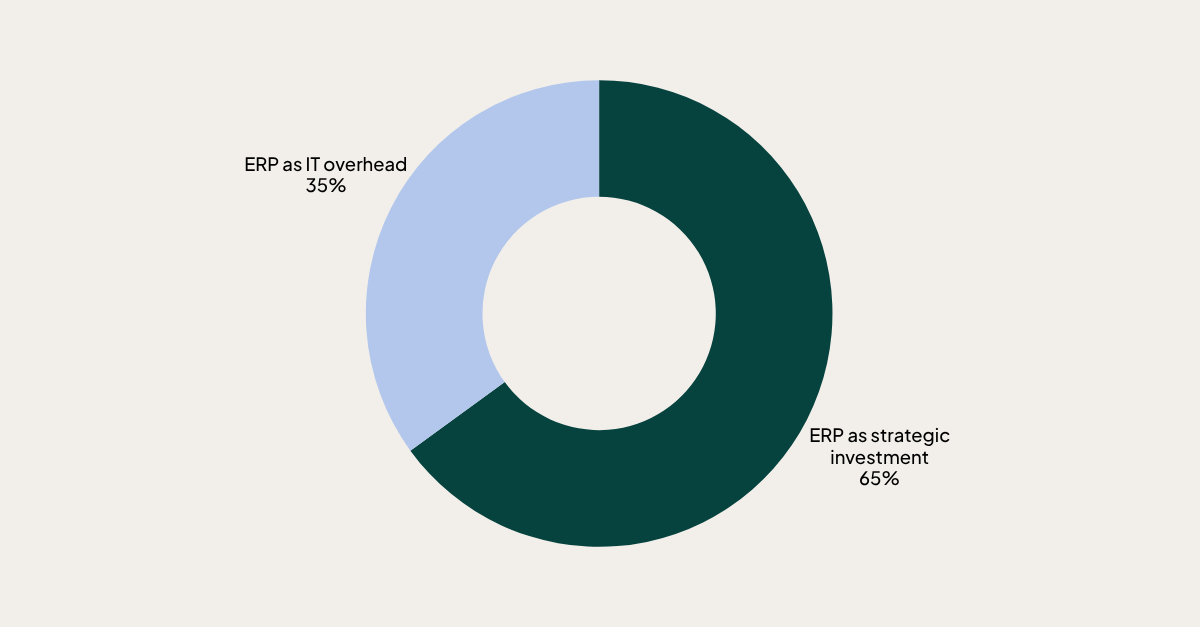
That perception is often outdated. Gartner predicts that 65% of organisations now consider integration capabilities a strategic investment, not an IT overhead. The market has responded with purpose-built connectors designed to bridge CRM and ERP without requiring a ground-up rebuild.
SuperOffice CRM connects with leading ERP systems used across Europe, including Visma, Business NXT, Tripletex, Fortnox, and others through ConnectERP, a purpose-built integration that requires no custom development.
The decision is not "do we undertake a major IT transformation?" The decision is: do we continue accepting the cost of disconnected systems, or do we close the gap?
Framed that way, it is a business decision. And one with a measurable return.
Worth knowing: SuperOffice CRM integrates with leading ERP systems through ConnectERP, enabling automatic data synchronisation between your CRM pipeline and your financial reality, without double entry, manual reconciliation, or the need for a dedicated IT project.
Clarity, control, and confidence in revenue
The goal of running a business is not to manage data. It is to make good decisions, quickly, with the information you have available.
When your CRM and ERP work in isolation, that goal becomes more difficult than it needs to be. Your teams end up spending more time to produce numbers that are less reliable. Your forecasts carry uncertainty that does not need to exist. And leadership conversations spend too much time on "which figure is right", and not enough on "what do we do next."
When your systems are connected, the business changes register.
Reporting becomes a source of confidence rather than a source of debate. Forecasting becomes a strategic tool instead of a quarterly ordeal. And the leadership team, CEO, CFO, Sales Director, finally share the same picture of where the business stands and where it is going.
That is not a technology upgrade. That is a better way of running a business.

Key takeaway
CRM and ERP integration eliminates the gap between your sales pipeline and your financial reality. It removes duplicate data entry, improves forecast accuracy, and gives every team - sales, finance, operations - the same real-time view of the business. For most companies, implementation is simpler than expected.
Want to see CRM and ERP integration in practice?
We're happy to show you how SuperOffice CRM works with your ERP. Get in touch and we'll take it from there.
FAQ
A CRM (customer relationship management system) tracks sales activity, leads, and customer interactions. An ERP (enterprise resource planning system) tracks financial and operational data, like invoices, orders, payments, and margins. CRM shows what's coming. ERP shows what happened.
CRM and ERP integration connects your customer management system and your financial/operational system so they share data automatically, eliminating manual re-entry and giving all teams a single view of the business.
Without integration, the same data must be entered manually into both systems, creating errors, duplication, and misaligned reports. Integration connects the two systems so data flows automatically, giving all teams a single, accurate view of the business.
When a deal is closed in the CRM, the relevant data like customer record, order details, deal value, flows automatically into the ERP, triggering invoicing and updating financial forecasts. No manual re-entry required.
Modern purpose-built connectors mean most businesses can integrate their CRM and ERP without a large IT project or custom development. The effort and cost depend on which systems you're using and how complex your data flows are.
Customer records, order information, invoicing data, payment status, and revenue figures - flowing automatically between systems when a deal is closed or an order is placed.
Yes. SuperOffice integrates with leading ERP systems, including Visma, Fortnox, Tripletex, and Business NXT, through ConnectERP, enabling automatic data synchronisation without manual reconciliation. There are also other connectors available in our App Store.


