
You can run great events and still struggle to prove they drive growth.
But when event engagement is connected to your customer journey, events become measurable accelerators.
The Problem: Your events create engagement, but the business impact remains unclear.
The Solution: Treat events as accelerators inside a connected, event-driven customer journey.
The Proof: Stronger follow-up, clearer attribution, and better customer experiences.
Events work. The measurement doesn’t.
B2B organisations invest heavily in events: conferences, breakfast seminars, webinars, roundtables, customer days.
You already know events can build trust faster than ads and emails.
The frustration starts later.
You see attendance and “good conversations”, but you struggle to show what changed in the customer journey.
That gap is rarely an event problem.
It’s a connection problem.
In many organisations, that starts with scattered customer data across systems, which makes it difficult to connect event engagement to pipeline, retention, or expansion.
The hidden gap in event-driven growth
In many organisations, events are still managed as standalone activities.
They are planned in one system, executed in another, and followed up… inconsistently.
This creates three common breaks in the chain:
- Engagement without insight: You see who attended, not what mattered to them.
- Participation without progression: Interest is real, but follow-up is late or generic.
- Activity without growth: The effort is high, but the impact on pipeline is unclear.
Most teams can report registrations and attendance.
Few can clearly explain what changed in pipeline, retention, or customer behaviour.
Without a clear connection to customer data, even the best events become isolated moments, not drivers of long-term value.
An event-driven customer journey fixes that by linking event engagement to customer data, enabling faster follow-up, more relevant interactions, and clear visibility into impact.
A relationship-based view of growth
Growth is a continuous process, not a linear funnel.
The Relationship Loop reflects this:
Awareness → Research → Evaluation → Purchase → Retention → Expansion → Advocacy
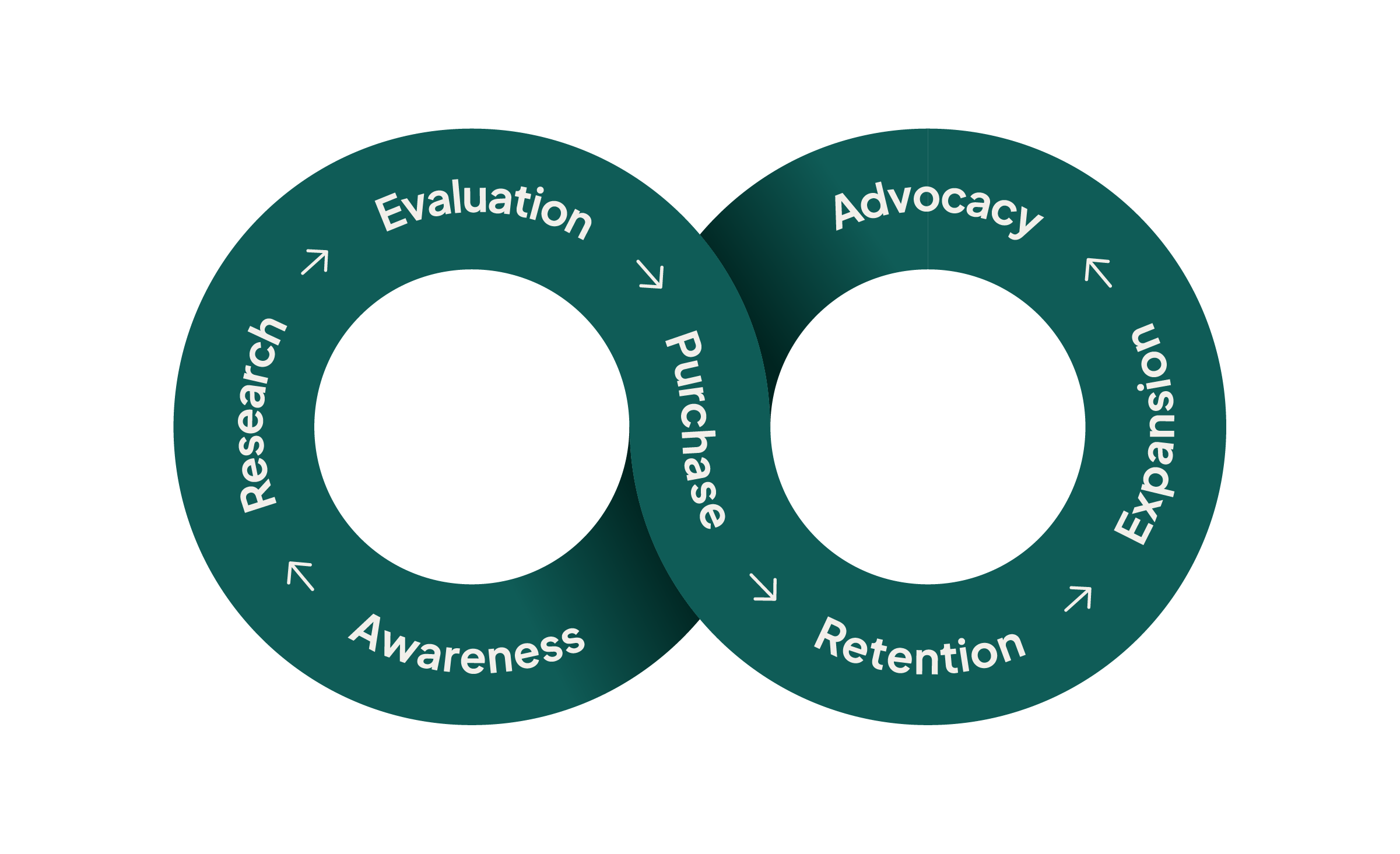
It matches how B2B buying actually happens. It is relationship led and shaped by many interactions over time, not a single conversion moment.
This matters for events because events are rarely limited to one stage.
Events influence decisions across the customer journey:
- A prospect attends a webinar to reduce risk.
- A customer joins a user group to learn faster.
- A champion brings a colleague to your conference.
So the practical question is not “where do events fit?”, it is:
What do events change in the customer’s decision-making at each stage?
Introducing: The event-driven Relationship Loop
Events play a unique role in the customer journey.
Not as a single touchpoint.
Not as a standalone activity.
But as high-impact moments that move customers forward.
In this framework, events act as accelerators across the entire Relationship Loop.
They don’t replace any stage.
They strengthen stages by increasing trust, reducing uncertainty, deepening relationships, and activating advocacy.
How events impact and accelerate the customer journey
Instead of asking where events fit, a more useful question is:
What do events change for the customer at each stage?
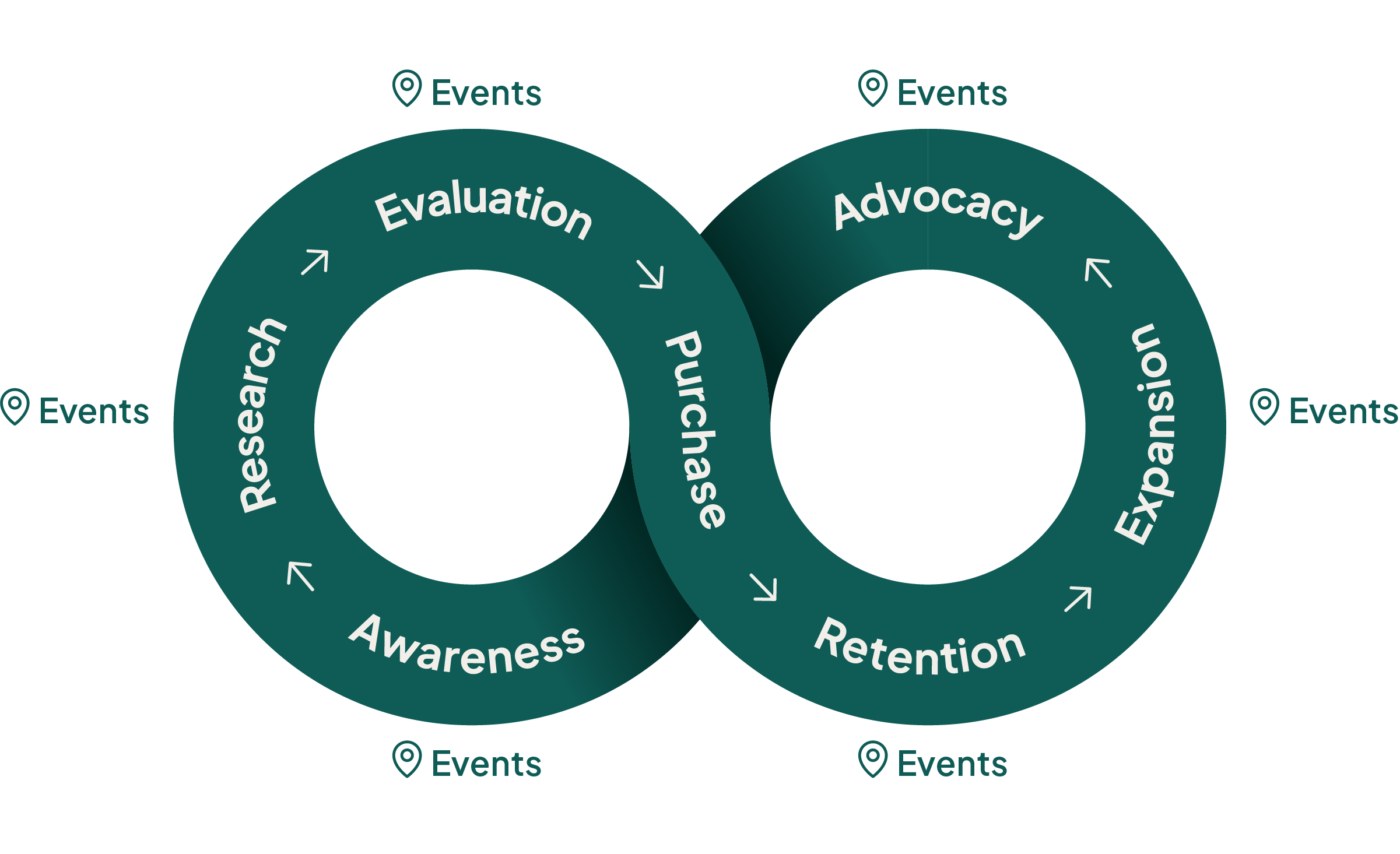
Awareness and research
Events transform visibility into engagement.
They give prospects a reason to lean in, ask questions, and connect with real people.
What changes for the customer:
- They move from passive interest to active learning.
- They get a “safe” way to explore without committing to a sales process.
- They start forming trust based on competence, not claims.
What you need to capture: topic interest, role, company, questions asked, sessions attended, and whether they engaged live or watched later.
Evaluation and purchase
Events reduce uncertainty and build confidence.
They provide clarity, reassurance, and real-world context at key decision points.
What changes for the customer:
- They understand trade-offs faster.
- They can validate fit by hearing examples and use cases.
- They feel supported, which lowers perceived risk.
What you need to capture: decision-stage signals (pricing session attended, demo request, stakeholder attendance, “next steps” questions).
Retention and expansion
Events reinforce value and strengthen relationships.
They turn “using a product” into “getting outcomes”.
What changes for the customer:
- They learn how to succeed faster.
- They see what good looks like through peers and experts.
- They become more confident internally, which supports renewal and growth.
What you need to capture: adoption signals, feature interest, customer health context, and attendance trends over time.
Advocacy
Events bring customers together.
They build community, knowledge-sharing, and momentum.
What changes for the customer:
- They stop feeling alone with the problem.
- They gain recognition by contributing.
- They become more willing to recommend you because they’ve experienced the relationship, not just the product.
What you need to capture: speaker participation, referrals, invites sent to peers, and community engagement.
The condition for impact
For events to deliver this value, one condition must be met:
Event data must be connected to the customer journey.
This is where many organisations already have the missing piece, but it often sits in separate systems.
When event interactions live outside your CRM:
- Insights are fragmented.
- Follow-up becomes inconsistent.
- Attribution becomes guesswork.
- Sales, marketing, and service see different versions of the customer.
This limits the ability to turn engagement into action.
When event data is connected, the picture changes.
You gain visibility into how events influence pipeline, relationships, and long-term growth.
You also gain the ability to decide what should happen next.
Where event management systems fit in this story
If your events are the accelerators, you need a system that makes that acceleration measurable and repeatable.
That means capturing event engagement as structured data and connecting it to your customer journey, not leaving it in separate tools or reports.
This is where event management platforms like Lyyti come in.
They help you run professional events, capture meaningful engagement data, and turn participation into signals your sales, marketing, and service teams can act on.
When event data is connected to your CRM, event activity becomes part of the customer record, not something that lives on the side.
That’s what makes follow-up faster, attribution clearer, and customer experience more consistent.
Pro tip: The biggest win is not better event reporting. It’s that your team stops treating events as one-off moments and starts treating them as part of how relationships progress.
What “connected” really means
A connected event-driven journey is not just syncing attendance.
It means event engagement becomes usable data your team can act on.
That requires three things:
- Identity: who engaged, at company and buying group level
- Context: how that engagement fits with sales, marketing, and service activity
- Action: what should happen next based on behaviour
Pro tip: If your team doesn’t know who to follow up with after an event, the issue isn’t the event. It’s that the data isn’t actionable.
The Event-to-Growth Playbook
Here’s a practical model you can use across webinars, field events, and customer programmes.
1) Define the job of each event
Every event should have a primary “job” in the Relationship Loop.
That job should be written as a customer outcome, not an internal metric.
Examples:
- “Help prospects understand the risks and trade-offs.”
- “Help new customers get value in the first 30 days.”
- “Help champions build internal support.”
- “Help customers learn one advanced workflow that saves time.”
When you define the job, you can measure whether the event did it.
2) Decide what signals matter
Track fewer metrics, but make them meaningful.
Good event signals are behavioural.
They show intent, confidence, or readiness.
Examples:
- Attended live vs. watched replay
- Asked a question
- Booked a meeting from the event
- Attended a deep-dive session
- Returned for a second event in the series
- Brought a colleague
3) Map signals to the next best action
This is where events become accelerators.
You stop sending the same follow-up to everyone.
You follow up based on what they actually showed you.
Examples:
- Asked implementation questions → route to service or onboarding expertise.
- Brought a colleague → equip the champion with a business case pack.
- Attended pricing session → sales follow-up within 24 hours with clear options.
- Customer attended advanced training → expansion conversation tied to outcomes.
4) Make follow-up fast and consistent
Speed matters because event engagement has a half-life.
If follow-up happens a week later, you’re no longer building on momentum.
Set a simple operational standard:
- Hot signals: follow up within 24 hours
- Warm signals: follow up within 3 working days
- Cold/no-show: follow up with value and a clear “next step”, not guilt
Pro tip: If follow-up depends on someone “remembering”, it will break under pressure. Automate the trigger, then personalise the message.
5) Connect events to opportunities and accounts
This is the measurement layer most teams miss.
You don’t need perfect attribution.
You need consistent association.
That means:
- Link attendance and engagement to the contact and the company/account
- Attach event activity to open opportunities
- Track buying-group attendance (not just single leads)
Then you can answer questions like:
- Which events influence late-stage deals?
- Which customer programmes reduce churn risk?
- Which topics create expansion conversations?
6) Use events to align sales, marketing, and service
Events are one of the few moments where all teams can contribute to the same customer outcome.
But only if everyone can see the same picture.
When event engagement sits in the CRM timeline, teams can coordinate:
- Sales follows up on intent.
- Marketing nurtures based on interest.
- Service supports based on adoption needs.
That’s when events stop being “marketing activities” and become relationship infrastructure.
7) Improve the journey with a feedback loop
An event-driven journey should get better every quarter.
Review performance through three lenses:
- Relevance: Did the right people attend?
- Progression: Did the next step happen?
- Impact: Did it influence pipeline, retention, or expansion?
If you can’t answer those, don’t add more events.
Fix the connection first.
From activity to growth
When events are integrated into the customer journey, they shift from being activities to becoming measurable drivers of growth.
You can:
- understand which events create real engagement
- follow up based on actual behaviour, not assumptions
- connect participation to opportunities
- improve continuously based on what moves the Relationship Loop
This is where events move from cost to capability.
Why this matters now
As B2B environments become more complex, organisations are under increasing pressure to:
- better understand impact
- improve customer experience
- align sales and marketing
- make better use of customer data
Events already play a critical role in achieving these goals.
The opportunity is not to do more, but to make events work as part of a connected system.
The takeaway
Events don’t belong to a single stage of the customer journey.
They influence all of them.
But their real value lies in what they do:
They accelerate the Relationship Loop.
When that acceleration is connected to customer data, it becomes visible, measurable, and scalable.
Ready to see what your events actually drive?
If you’re investing in events but struggling to connect them to growth, the issue may not be the events.
It may be how event engagement is integrated into your customer journey.
When event engagement is connected with CRM, interaction becomes insight, and insight becomes action.
That is what turns events into pipeline, retention, and measurable growth.
See how connected event management and CRM turn event engagement into pipeline, retention, and measurable growth.


