
In short
Choosing the right CRM starts with understanding your business needs, not the vendor's feature list. Evaluate candidates on five criteria: GDPR compliance and data residency, AI-powered adoption features, European localization and partner support, ease of use, and total cost of ownership. Request personalized demos, compare at least two vendors, and check references before deciding.
CRM selection has fundamentally changed in the last couple of years. Modern CRM selection for European B2B businesses now hinges on compliance, AI readiness, adoption likelihood, and genuine alignment with how your team works.
Many companies still approach CRM selection the old way. They shortlist three vendors, request demos, and pick the one with the slickest sales pitch. The result? 70% of CRM implementations fail to meet their goals. Not because the software is poor, but because the chosen platform doesn't fit the actual business or nobody uses it.
The cost of choosing wrong goes beyond failed adoption. In SuperOffice's 2026 European relationship gap research, companies without a structured CRM view were more than twice as likely to miss warning signs on accounts or deals. They also spent an average of four or more hours per week just searching for and updating customer information, time that could be spent selling instead.
This guide walks you through a smarter vendor evaluation process. One grounded in what matters for growing European B2B companies looking to choose a CRM that delivers real results.
Start here: five questions about your business, not vendors
Before you look at a single CRM demo, answer these questions about your own operation.
1. What specific problems will a CRM solve?
Don't say "visibility" or "better forecasting." Be concrete. Is your sales team losing deals because follow-ups fall through the cracks? Is managing customer data taking hours every week instead of minutes? Is marketing sending leads that never get touched?
2. How many users, and what do they need?
A sales rep needs something very different from a marketing person or a customer service team member. Some CRM vendors charge per user regardless of which features you use; others let you buy only what you need. Know your team.
3. What systems do you already use?
Your CRM doesn't exist in isolation. It needs to talk to your email, your accounting software, your ERP (if you have one), and ideally your marketing tools. Jot down the three to five systems your business depends on every day.
4. What's your compliance and data geography?
If you're in Europe, GDPR isn't optional. It's the foundation. Where does your data need to live? Do you need EU data residency, or is a global provider with an EU data option acceptable? Do you need specific certifications like ISO or SOC 2?
5. What's your realistic budget and timeline?
CRM pricing is rarely what it looks like on the website. Account for setup, customisation, training, and integration work. Set a budget that includes these hidden costs, not just per-seat licensing.
Once you've answered these five, you know what you're looking for. Now evaluate vendors against it.
Five core criteria for selecting a CRM in 2026
1. GDPR compliance and data residency
For European businesses, this is non-negotiable. It's also where many global vendors create friction.
A GDPR-compliant CRM means the vendor can handle data subject access requests, consent management, and the right to erasure natively. A few clicks, not weeks of manual work.
This matters more than many businesses realise. Without proper systems in place, manual compliance work drains resources. According to SuperOffice's 2026 European relationship gap research, companies without structured CRM systems spend significant time just locating and managing customer data across spreadsheets, emails, and disconnected systems. That scattered data makes compliance harder and slows your team down.
Look for:
- EU data hosting. Your customer data stays in Europe, by default
- A signed Data Processing Agreement (DPA). This is a legal requirement, not optional
- Native GDPR features. Consent management, deletion workflows, audit logs
- ISO 27001 or SOC 2 Type II certification. Proof of security controls
Don't settle for "we offer EU storage as an add-on" or "we can do GDPR compliance if you ask us nicely." The best CRM vendors for your market have data privacy and compliance baked in from the start.
Why European B2B teams choose differently
See why GDPR compliance, local support, and ease of adoption matter more than global features lists for European businesses.
2. AI-powered features that drive adoption
AI in CRM isn't novelty anymore. It's table stakes. But not all AI is created equal.
In 2026, what separates effective AI from flashy demos is adoption. Choose a CRM where AI is built into the core product, not bolted on as an expensive add-on.
What to look for:
- AI in every plan. Available from day one, not reserved for Enterprise-tier users
- Practical automation. Lead scoring, next-step recommendations, automatic follow-up suggestions. Real workflows, not just dashboards
- Native integration with your work. AI that surfaces inside the tools your reps already use daily
Companies using CRM with integrated AI are 83% more likely to exceed their sales goals. But only if the team adopts it. A powerful AI-supported CRM that nobody uses is worthless.
3. European localisation and partner ecosystem
European B2B businesses have unique needs that global vendors often overlook.
You need multi-currency functionality, local tax handling (reverse charge, VAT management), and integrations with regional accounting tools. If you're in the Nordics, you might need Visma integration. In Germany, DATEV integration matters. In Switzerland, you want bexio support.
More importantly, you need a local partner who speaks your language and understands your market. Most successful CRM implementations in Europe involve a local partner for onboarding and support, not just a global vendor helpdesk.
When evaluating vendors, ask:
- Do you have local partners in our country or region?
- Can they provide onboarding and ongoing support in our language?
- How many implementations have they completed in our industry?
4. Ease of adoption and user experience
The best CRM feature in the world is worthless if your team doesn't use it.
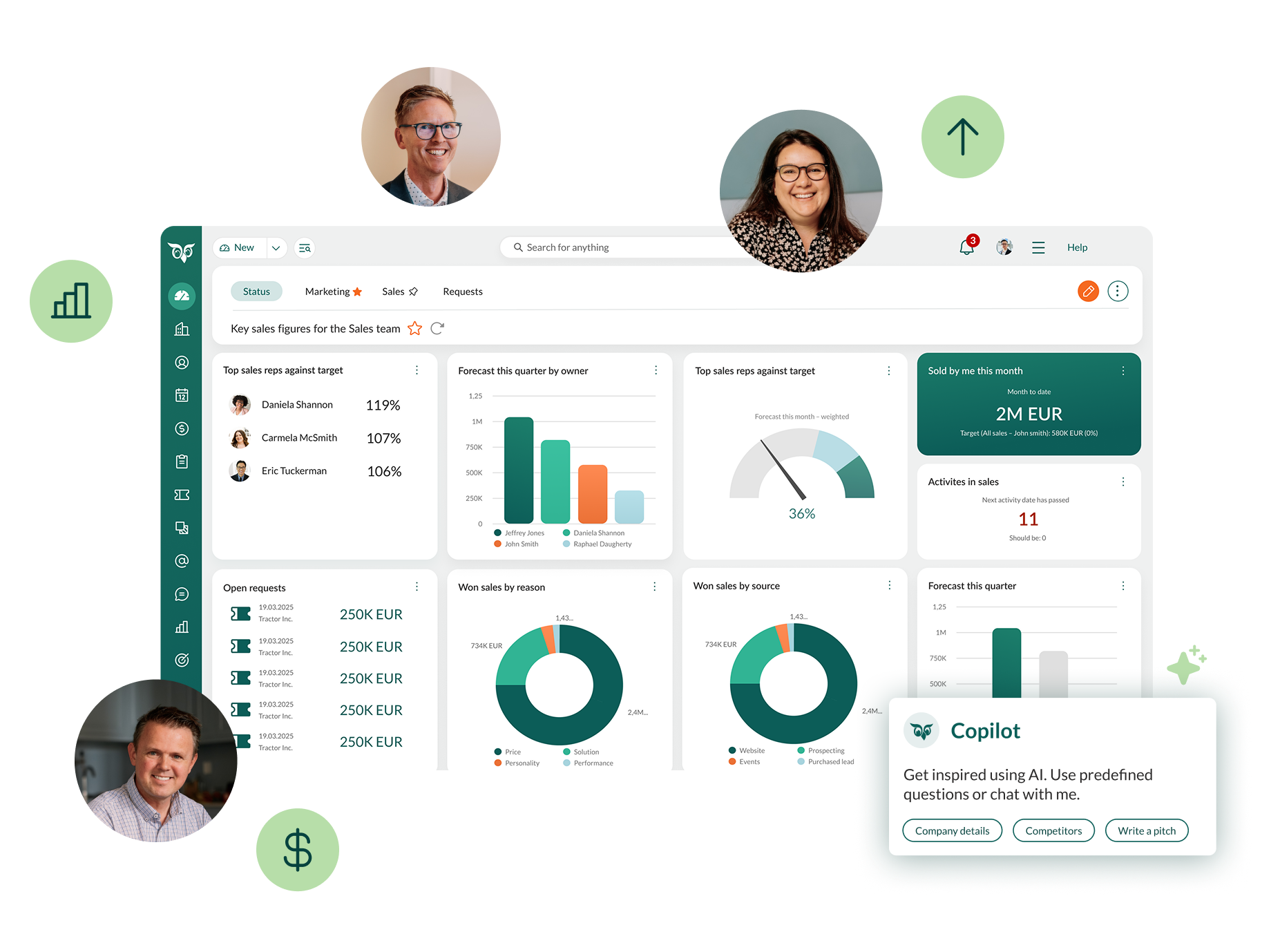
User experience matters more than an endless feature list. What matters is simple: can your average sales rep, without an IT degree, log in, find a contact, and update a deal in under a minute?
Consider this: according to SuperOffice's 2026 European relationship gap research, teams with well-designed, structured CRM systems feel confident in their account view 87.5% of the time. Teams without proper systems? Only 39.4% feel that same confidence. That gap reflects user experience directly. If your team doesn't trust or enjoy the interface, they won't use it consistently.
During a demo, invite two or three actual users to watch along: a sales rep, a manager, someone from marketing. Ask them these questions as you go:
- Is the interface intuitive?
- Do you understand what each button does?
- How many clicks to complete a typical task (log a call, move a deal to the next stage)?
- Would you want to use this every day, or does it feel like work?
If your team groans at the interface, adoption will fail. No amount of features can fix that.
5. Total cost of ownership, not just per-user pricing
A CRM's monthly invoice is just one part of the cost.
Include:
- Per-user licensing. The obvious part
- Implementation and setup. Configuration, customisation, data migration (often €2,000 to €15,000+ for small to mid-market businesses)
- Training. Both initial and ongoing
- Integrations. Connecting to your other systems (€1,000 to €5,000 depending on complexity)
- Add-ons. If advanced reporting, AI, or mobile access cost extra, budget for them
Some vendors advertise low per-user pricing but charge heavily for setup and add-ons. Others have higher per-user costs but include everything. Compare the total, not just the headline price.
Also ask: what happens when you add more users or features? Does pricing scale linearly or does it jump per tier?
How to evaluate vendors: a practical process
You now know what to look for. Here's how to narrow your shortlist and choose.
Step 1: Screen for your core requirements.
Does the CRM have GDPR compliance? EU data hosting? Local support in your region? If not, eliminate it. You shouldn't have to negotiate the basics.
Step 2: Request a personalised demo.
Skip the generic product tour. Ask the vendor to walk through your specific use case. Come prepared with a real scenario: "Here's how we currently track a deal from initial contact to close. Can you show us how your CRM handles this?"
Step 3: Request a hands-on walkthrough.
Ask the vendor for a personalized follow-up where they configure a demo with your actual use cases. Many vendors offer this as part of evaluation. It lets your team see the system working with scenarios that match your business, not just generic examples.
Step 4: Compare at least two vendors.
Don't fall in love with the first demo. Request demos from two or three vendors on your shortlist and compare them side by side. Which one did your team like using?
Step 5: Check references and reviews.
Visit third-party review sites like G2, read recent reviews from companies in your industry and size range. Look for patterns and consistency, not just five-star ratings from tiny samples.
Step 6: Understand implementation and support.
Ask the vendor or their partner:
- How long is a typical implementation for a company your size?
- How much of that time involves your team versus theirs?
- What does ongoing support look like after launch?
- How are feature updates handled? Can you stay on an older version if needed?
Conclusion
Choosing the right CRM isn't about finding the vendor with the longest feature list or the lowest price. It's about finding the system that will be used by your team, complies with your legal requirements, and grows with your business.
For European B2B companies, that increasingly means a full CRM suite built for your region, with strong GDPR compliance, integrated AI that drives user adoption, and a local partner ecosystem.
The evaluation process takes time, but it's worth it. A CRM chosen well pays dividends for years. One chosen poorly becomes shelfware and wastes both budget and team energy.
FAQ
There is no single "best" CRM, it depends on your specific needs, budget, and team size. However, the best CRM for a European B2B business should meet these minimum criteria: GDPR compliance with EU data hosting, integrated AI features that support adoption, strong local partner support, and transparent pricing. Evaluate vendors on these criteria rather than features alone.
Evaluation typically takes 4 to 8 weeks if you follow a structured process (screening, demos, vendor comparisons, references). Implementation varies widely based on your setup complexity, but plan for 2 to 6 months for a small to mid-market business. Budget includes setup, data migration, customisation, and training.
Features matter, but adoption matters more. A CRM with every imaginable feature that your team refuses to use is worthless. Prioritise ease of use and ensure the core features you need are present. Remember that 70% of CRM projects fail due to poor adoption, not poor software.
Ask whether GDPR compliance is native or requires additional configuration. If they say "it's complicated" or "we can figure it out," move on. Also ask about hidden costs (setup, training, integrations). If pricing is vague or per-feature, be cautious.
Yes, but it's costly and disruptive. You'll need to export and migrate your data, retrain your team, and rebuild workflows. It typically costs 40 to 60% of the original implementation investment and takes 2 to 3 months. It's better to choose thoughtfully upfront than to switch later.
For a 20-person European B2B company, expect €300 to €800 per month in per-user licensing (depending on features), plus €3,000 to €8,000 for implementation, setup, and initial training. Annual total cost of ownership is typically €5,000 to €15,000 for year one, then €4,000 to €10,000 annually for licensing and support thereafter.


