
B2B teams don't need convincing that AI matters anymore. Every major CRM platform has shipped some form of AI agent in the past year, and the conversation has moved from “should we use AI" to "which parts of the job should it touch”.
That's the more useful question. Bolted onto the side as a separate chat window, AI is one more tab to check. Built into the CRM your team already works in, it becomes something else: context and action that are there before you ask for them.
The problem: Most businesses still treat AI as a tool next to their CRM, not part of it – so the insight rarely reaches the moment it's actually needed.
The solution: AI agents built into the stages of a customer relationship, inside the CRM your team already uses, rather than a separate assistant to remember to open.
The proof: SuperOffice's own data shows that teams who automate admin typically reclaim several hours per rep, per week – without adding headcount.
Before we start, what are AI agents in CRM?
AI agents in CRM are software that act on your customer data within set limits – flagging a stalling deal, drafting a reply, or filling in a missing company record – instead of just answering questions when asked. Unlike a chatbot, an agent works proactively inside the system that already holds your customer relationships, so it can act on real, current data rather than whatever you happen to type in.
AI agents are now standard in CRM, the question is how to use them
The technology shift is real: 37% of sales teams now use AI in some form, with that figure expected to double within the next year. Most major CRM vendors now ship some version of an agent that watches for signals – a stalled deal, an unanswered request – and acts on them without being asked each time.
But adoption is outrunning readiness. According to Gartner's 2026 Hype Cycle for Agentic AI, only 17% of organisations have deployed AI agents so far, even though more than 60% expect to within two years – one of the steepest adoption curves Gartner tracks. Gartner's own read on the discrepancy: autonomous agents aren't ready yet for most enterprise use cases, and the governance, security, and trust mechanisms needed to run them safely are still maturing.
This is not a technology issue, but an imbalance in workflow and data quality. The businesses pulling ahead aren't the ones with the most AI features. They're the ones who've moved AI into the flow of real customer work; on top of data they can trust.
Where AI agents strengthen a CRM
Four areas make the real difference, and none of them require replacing anything your team already does.
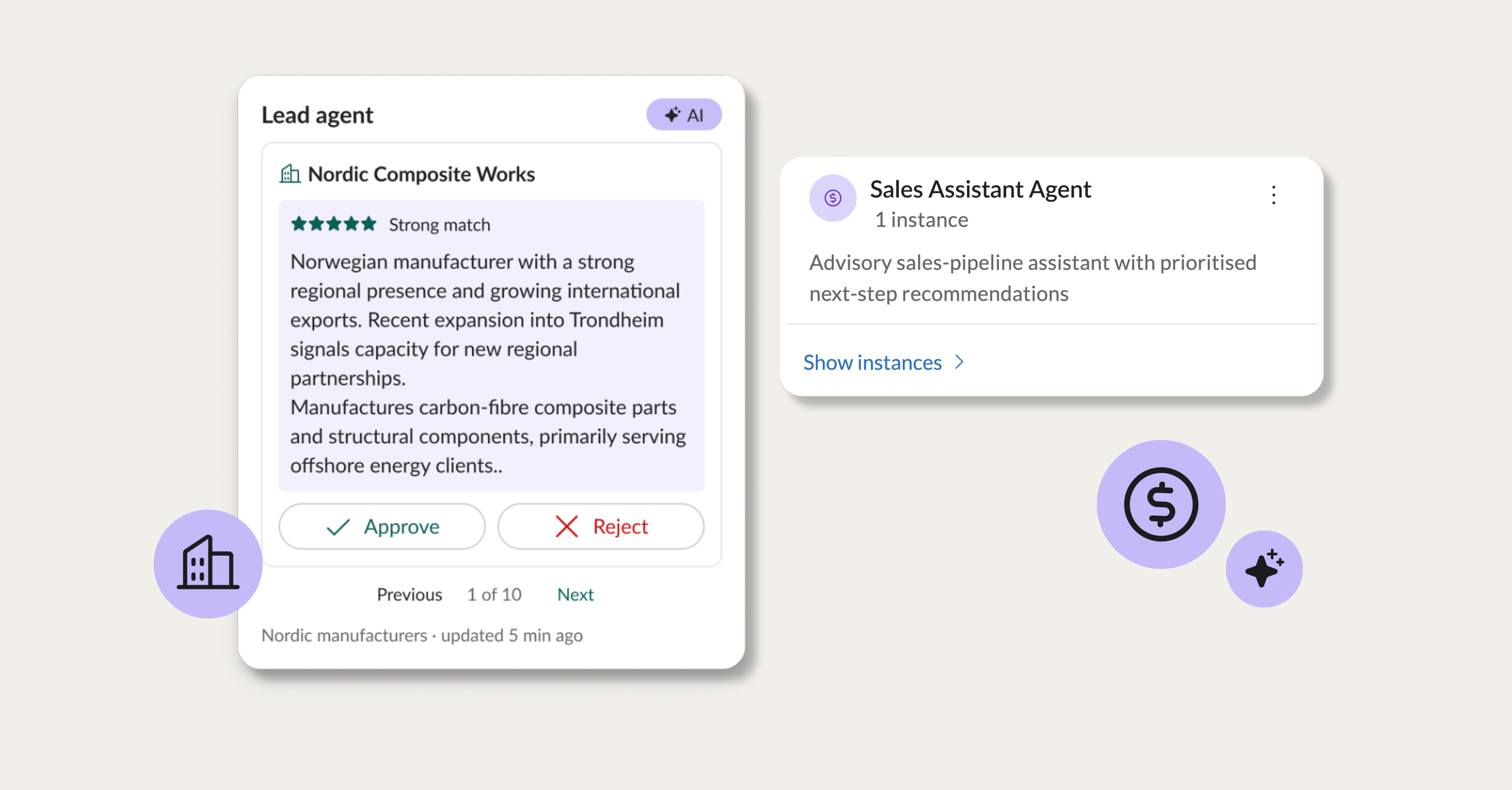
Prospecting and enrichment. Instead of a rep manually researching whether a lead fits the ideal customer profile, Lead Agent can search for and check prospects against your criteria before they ever reach a rep's desk. Once a lead is approved, Company Insight fills in the company record straight from official business registries, rather than leaving a half-empty profile for someone to complete later.
Pipeline and meeting intelligence. Deals go quiet for reasons that are usually visible in the data long before a rep notices; a follow-up that never happened, a proposal that's sat untouched for three weeks. Sales Assistant Agent watches for these patterns and flags what's stalling before it's lost. Day to day, Workspace Assist answers quick questions and pulls summaries on demand, like "what do I need to know about this account before my call today?" without a rep hunting through five tabs to piece it together.
Worth knowing: SuperNotes, available on all plans, handles the unglamorous work of turning a meeting into a usable record. It pulls context together beforehand and saves a clean summary straight back to the CRM. No manual notetaking, no forgotten follow-up drafted from memory three days later.
Response and retention. When a customer needs a reply, speed and accuracy usually trade off against each other. Reply Assist drafts a reply from a customer's own history and data – with a person always reviewing before it sends – removing that trade-off. The same logic applies to churn: fewer logins, slower replies, and unresolved tickets are all visible signals long before a renewal conversation goes badly.
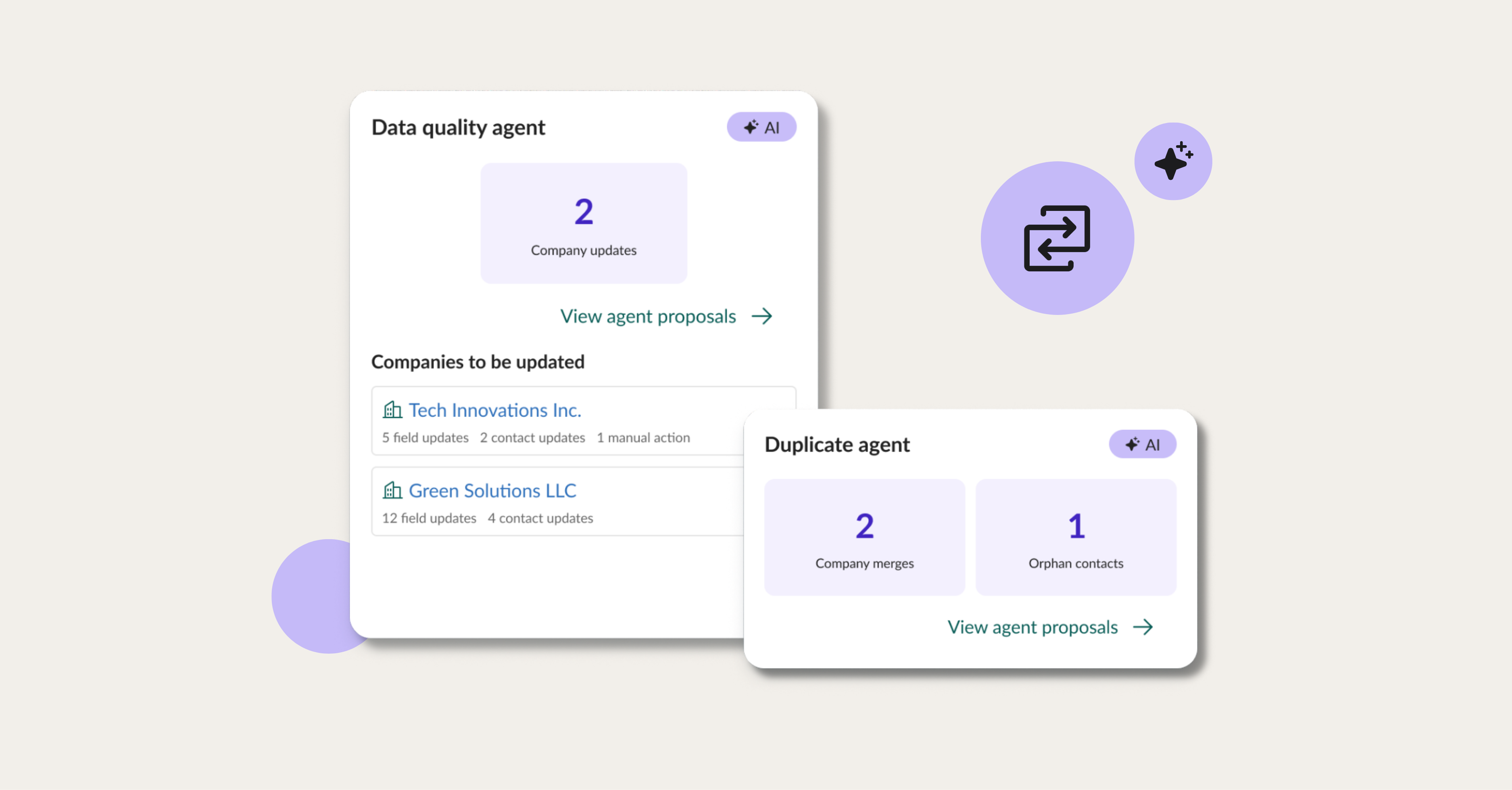
Working quietly underneath all of it. None of the above is worth much on top of messy records. Data Quality Agent and Duplicate Agent work across every stage, catching duplicates and closing gaps so the other agents have something reliable to act on. And because the point of an agent is to meet you where you already are, MCP Connect brings your live CRM data into the AI assistant you already use – Claude, Copilot, or ChatGPT – instead of asking you to open one more tool.
Pro tip: Lead Agent, Sales Assistant Agent, Reply Assist, MCP Connect, and Data Quality Agent are all currently in early access, so availability depends on your plan. Predictive analytics for churn and pipeline risk, however, is something you can act on today with the data already in your CRM.
The difference between an AI agent and an AI assistant
An AI assistant, like Workspace Assist, responds when you ask a question or need a quick summary. An AI agent, like Lead Agent or Sales Assistant Agent, works proactively in the background, watching for signals and acting – or flagging – without waiting to be asked each time.
The real win is in the relationship, not the agent
None of this matters if customers don't trust what is happening with their data, and with the EU AI Act's stricter rules for high-risk systems now taking effect, that trust question is no longer optional for European businesses.
That means being specific and transparent with your processes: what gets recorded, who can see it, how long it's kept, and – increasingly – where the AI itself does its processing. How SuperNotes handles meeting data is a useful example of what this looks like in practice: GDPR-compliant by design, not as an afterthought.
It also means the agent is only as good as the data behind it. Gartner's adoption-versus-readiness divide above is a good reminder to fix the foundations, which is exactly why data quality is the actual foundation of any AI strategy.
Bottom line: AI agents don't replace the relationship-building work. They remove the admin standing in front of it.
FAQ
No, an agent needs somewhere to read customer context from, and a CRM is usually that source. Agents make the CRM more useful; they don't make it optional.
No. Smaller B2B teams often feel the benefit more acutely, since admin work that would otherwise fall on a handful of people gets automated rather than absorbed by a dedicated ops team.
A standalone assistant answers questions from what you tell it. An agent built into a CRM already has the customer's history, so it can answer – or act – with context you didn't have to type in.
SuperNotes and Company Insight are available now. Lead Agent, Sales Assistant Agent, Reply Assist, MCP Connect, and Data Quality Agent are currently in early access, with availability varying by plan.
Curious which of these agents are relevant to how your team actually works? Get in touch and we'll walk through what's live today versus what's coming next.


